Mingyue Tang

Research

Projects and publications.

Wireless sensing with mmWave and FMCW radar
ChirpEye MobiCom 2025
BSENSE SenSys 2024
Low-power backscatter systems and localization
Bistatic ranging for tag localization SPIE 2026
Extended-range two-way radar backscatter MobiCom 2024 poster
Machine learning for sensor and physiological signals, with applications in health and agriculture
Vital signs from radar SenSys 2024
Earlier wearable and mobile sensing 2022 to 2023

Research Projects

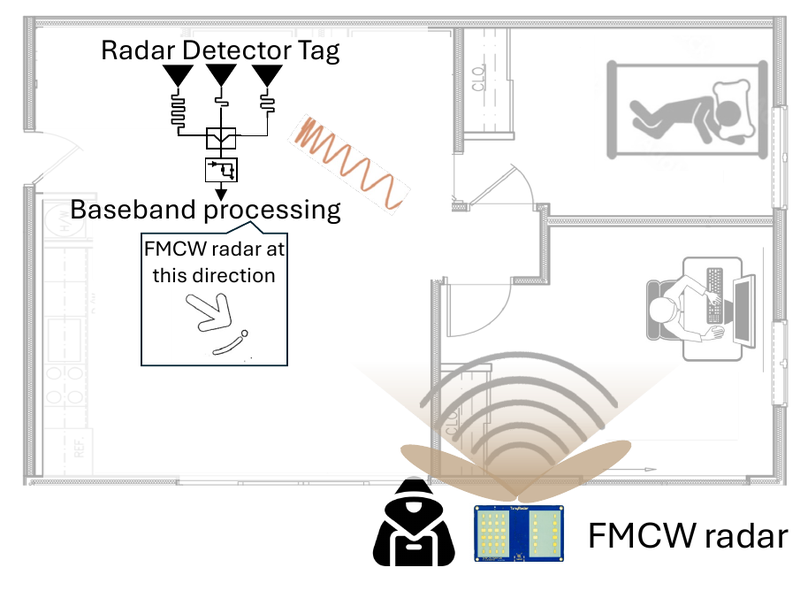
Floor plan in which a radar detector tag estimates the direction of a hidden FMCW radar

ChirpEye: Passive Sensing and Profiling of FMCW Radars

ACM MobiCom 2025, co-first author

Can a low-power tag detect a nearby FMCW radar and work out its configuration with no prior knowledge of it?

A passive tag uses delay lines to turn GHz radar chirps into kHz beat tones, detecting radars with 99% accuracy up to 15 m and estimating their chirp slope and direction.
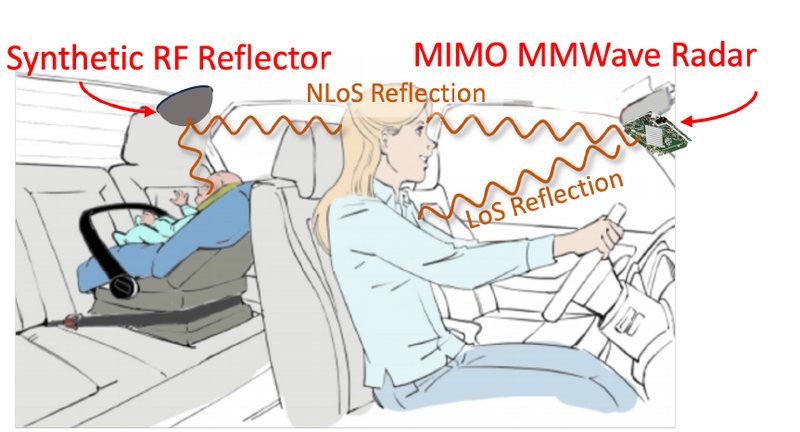
Car interior sketch in which a synthetic RF reflector bounces mmWave radar signals toward a rear-facing child seat

BSENSE: In-Vehicle Child Detection and Vital Sign Monitoring

ACM SenSys 2024, first author

Can a single mmWave radar find a child left in a car, including in a rear-facing seat it cannot see directly?

Passive reflectors cover the radar’s blind spots, and a multi-task model detects child presence and estimates breathing rate, with over 97% detection accuracy and under 6 breaths per minute of error.

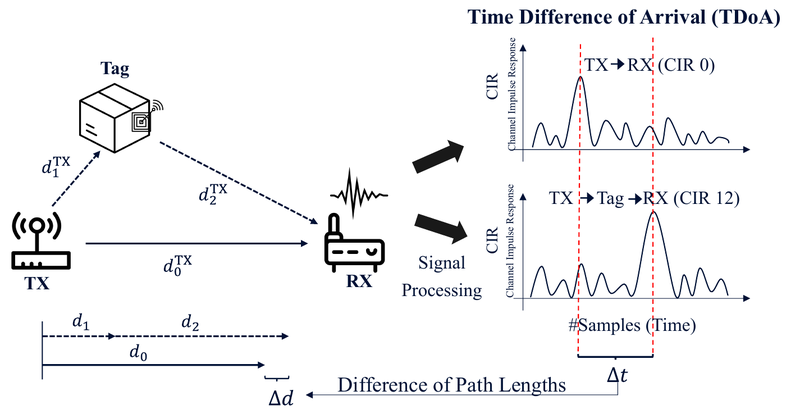
Bistatic backscatter setup in which the time difference between the direct and tag-reflected channel impulse response peaks gives the path-length difference

Machine Learning-Based Bistatic Ranging for Backscatter Tag Localization

Nokia Bell Labs internship, SPIE Defense + Security 2026, patent accepted

How can low-power backscatter tags be located accurately in multipath-rich industrial environments?

A machine learning framework performs time-difference-of-arrival ranging from pairs of channel impulse responses, halving positioning error compared with conventional methods in real industrial tests, and a calibration step adapts it to new sites with little data.

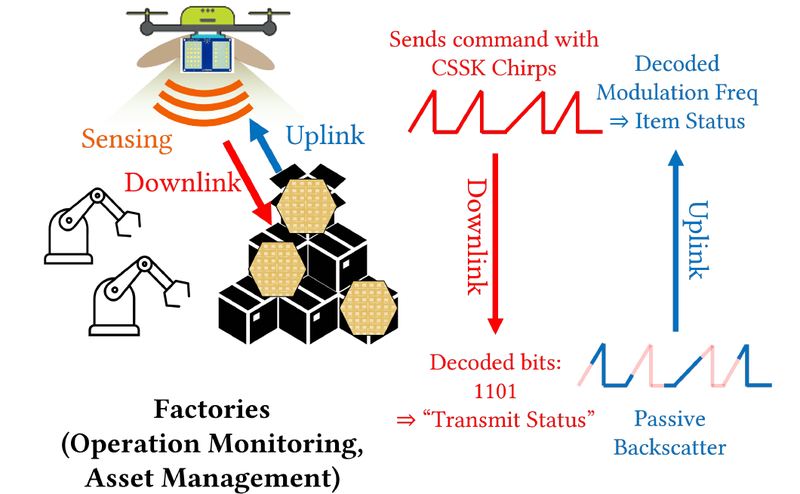
Drone-mounted radar sending chirp-coded commands to backscatter tags on factory boxes, which reply on the uplink

Extended-Range Two-Way Radar Backscatter Communication

ACM MobiCom 2024 poster, second author

Can a low-power tag exchange data with an off-the-shelf FMCW radar over longer distances?

A two-antenna tag design extends downlink range by 46% at the same 6 kbps throughput.

Earlier Projects

  • FluiSense: multi-modal mobile sensing for better fluid control in end stage kidney disease patients. Advised by Prof. Mehdi Boukhechba
  • SIMS: Social Interactions Monitoring Study: monitoring social state anxiety with wearable sensors and webcams. With Zhiyuan Wang, advised by Prof. Laura Barnes
  • Federated Learning on IoT Data: optimizing the accuracy of collaborative training on data from IoT edge devices while preserving privacy. With Jiechao Gao, advised by Prof. Brad Campbell
  • Graph Unsupervised Representation Learning: a new unsupervised approach to graph learning that addresses limitations of graph autoencoders, graph structure learning, and infomax-based methods. Advised by Prof. Carl Yang and Prof. Pan Li

Selected Publications

Full list on Google Scholar. * equal contribution.

2026

  1. Physics Unrolled Neural Operator for Wireless Field Modeling

    Rafid Umayer Murshed, Saif Ur Rahman, Mingyue Tang, Elahe Soltanaghai

  2. Generalizable Machine Learning-based Bistatic Ranging for Backscatter Tag Localization

    Mingyue Tang, Kartik Patel, John Kimionis

  3. “My Credentials, Please”: Detecting Filesystem Capability Laundering in MCP Servers at Scale

    Zeqian Huang, Mingyue Tang, Aonan Guan, Qiming Sun, Pengzhou He

2025

  1. ChirpEye: Passive Sensing and Profiling of FMCW Radars with a Resource-constrained Tag

    Mingyue Tang*, Jizheng He*, Ryu Okubo, Dhruv Panchmia, Elahe Soltanaghai

  2. Atlas: Ensuring Accuracy for Privacy-Preserving Federated IoT Applications

    Jiechao Gao*, Mingyue Tang*, Wenpeng Wang, Tushar Routh, Bradford Campbell

2024

  1. BSENSE: In-vehicle Child Detection and Vital Sign Monitoring with a Single mmWave Radar and Synthetic Reflectors

    Mingyue Tang, Pranshu Teckchandani, Jizheng He, Hanbo Guo, Elahe Soltanaghai

  2. Extended-Range Two-way Radar Backscatter Communication with Low-Power IoT Tags

    Jizheng He, Mingyue Tang, Ryu Okubo, Dhruv Panchmia, Elahe Soltanaghai

2023

  1. Personalized State Anxiety Detection: An Empirical Study with Linguistic Biomarkers and Machine Learning Pipeline

    Zhiyuan Wang, Mingyue Tang, Maria A. Larrazabal, Emma Toner, Mark Rucker, Congyu Wu, Bethany A. Teachman, Mehdi Boukhechba, Laura E. Barnes

  2. SRDA: Mobile Sensing based Fluid Overload Detection for End Stage Kidney Disease Patients using Sensor Relation Dual Autoencoder

    Mingyue Tang*, Jiechao Gao*, Guimin Dong, Carl Yang, Bradford Campbell, Jamie Zoellner, Brendanand Bowman, Emaad Abdel-Rahman, Mehdi Boukhechba

  3. GNNs in IoT: A Survey

    Guimin Dong, Mingyue Tang, Zhiyuan Wang, Jiechao Gao, Sikun Guo, Lihua Cai, Robert Gutierrez, Bradford Campbell, Laura E. Barnes, Mehdi Boukhechba

2022

  1. PFed-LDP: A Personalized Federated Differential Privacy Framework for IoT Sensing

    Jiechao Gao*, Mingyue Tang*, Tianhao Wang, Bradford Campbell

  2. Mobile Sensing in the COVID-19 Era

    Zhiyuan Wang*, Haoyi Xiong*, Mingyue Tang, Mehdi Boukhechba, Tabor Flickinger, Laura Barnes

  3. Dynamic Network Anomaly Modeling of Cell-Phone Call Detail Records for Infectious Disease Surveillance

    Carl Yang*, Hongwen Song*, Mingyue Tang, Leon Danon, Ymir Vigfusson

  4. Graph Auto-Encoder via Neighborhood Wasserstein Reconstruction

    Mingyue Tang*, Carl Yang*, Pan Li

  5. Using Ubiquitous Mobile Sensing and Temporal Sensor-Relation GNN to Predict Fluid Intake of End Stage Kidney Patients

    Mingyue Tang, Guimin Dong, Jamie Zoellner, Brendanand Bowman, Emaad Abdel-Rahman, Mehdi Boukhechba